www.gsmgateway.in

Good communication is key to operational success in business today. Your choice of
telecom system has a direct impact on your customer experience
and cash flow, no matter whether you operate a secure bank, a growing BPO, or a quickly
growing e-commerce site.
When structuring your business communication, the ultimate decision often comes down to
two major technologies: PRI (Primary Rate Interface)
and SIP (Session Initiation Protocol) Trunking.
Your current configuration, capacity needs, and future expansion goals all play a major
role in selecting the best alternative. Let's analyze
how these technologies work, how they differ, and how modern gateway solutions can help
you in close the gap between modern range and legacy
dependable.
To make an informed decision, it is essential to understand how each technology establishes connections.
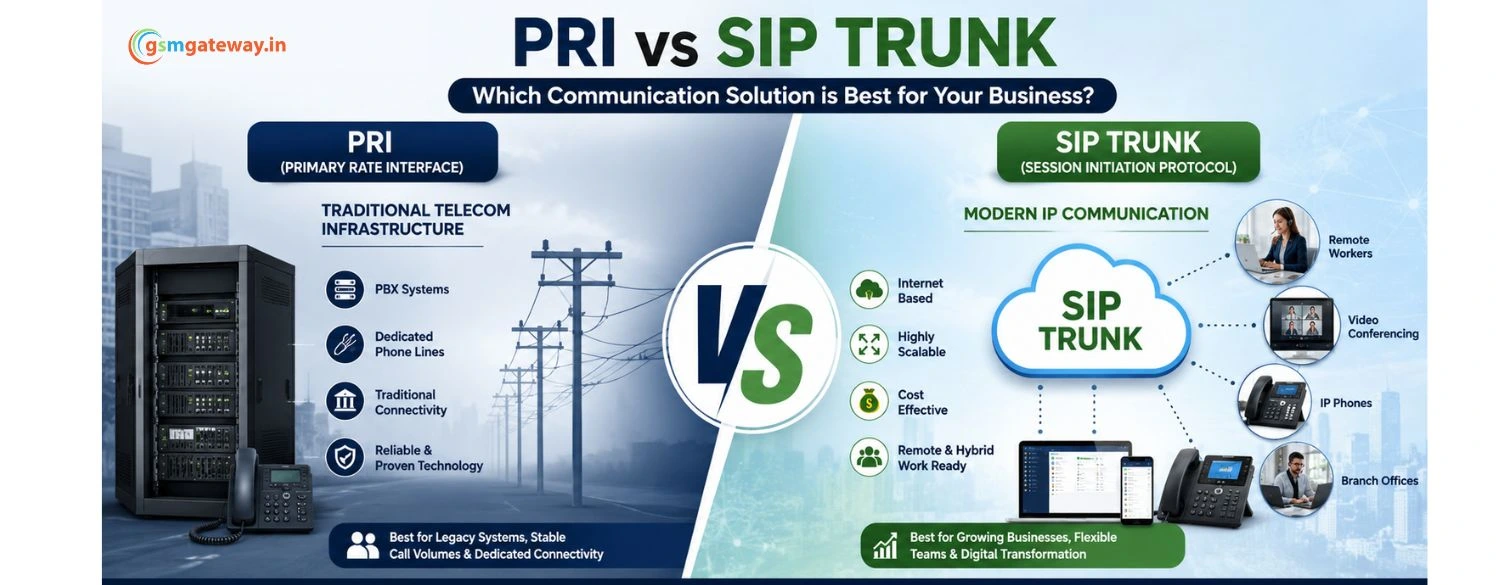
Multiple speech and data transmissions are sent across a physical copper wire network (more precisely, a T1 or E1 line) using PRI, a normal, physical telecommunications protocol. A typical E1 PRI line, which is popular in India, allows for up to 30 channels at once, so your company may manage 30 calls at once.
A sip trunk is a virtual phone line that connects your private branch exchange (PBX) to the public switched telephone network (PSTN) via your internet connection. SIP trunking, in line with physical lines, is totally dependent on data networks, allowing nearly infinite concurrent call channels that may be quickly scaled up or down.
| Feature | PRI Lines | SIP Trunking |
|---|---|---|
| Infrastructure | Physical copper cables (E1/T1 lines) | Virtual, over internet/data networks |
| Scalability | Rigid (Increments of 30 channels) | Highly flexible (Add 1 or 100 channels instantly) |
| Disaster Recovery | Tied to a physical location | Geographically redundant, easy rerouting |
| Maintenance | Higher maintenance and hardware dependency | Lower maintenance, managed digitally |
Operational challenges are unique to each business. Finding the best infrastructure will be made easier by finding your main problems.
Traditional on-premise PBX gear has been much invested in by multiple governments,
hospitals, and well-known companies. It is not profitable
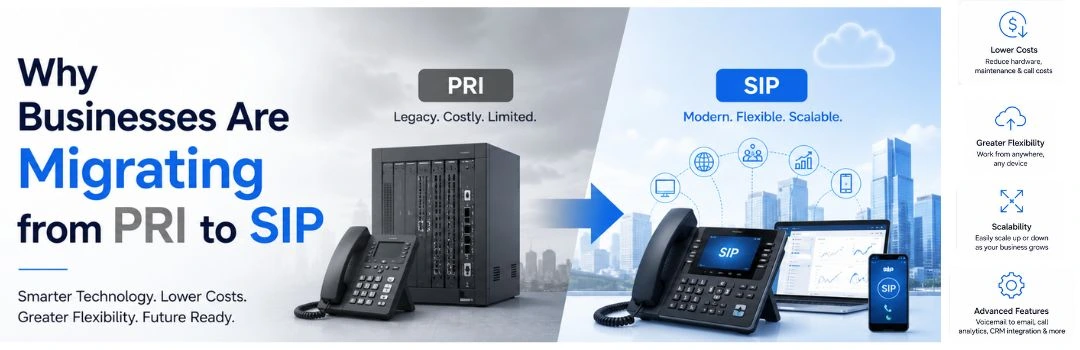
to remove and update this system.A pri to sip or pri voip gateway comes in quite handy
in this case.
By serving as a translator, these devices enable you to link your
dependable, outdated PRI hardware to a modern SIP network. You don't have to give up
your
past hardware investments to enjoy the value of modern VoIP.
Call volumes vary quickly for BPOs, e-commerce platforms, and modern call centers. If
you only employ physical lines, you will either have to deal with busy signals during
high traffic or overpay for unused capacity during idle seasons.The interactions scaling
these sectors need is provided by SIP trunking.
However, many high-volume companies use a hybrid strategy to guarantee maximum uptime.
Businesses can maintain a steady PRI linefor baseline traffic and smoothly overflow
excess
calls into a SIP network by using a pri gateway, ensuring 100% operational reliability.
Static physical connections can limit productivity if your team is dispersed or largely dependent on mobile networks. Businesses can route landline traffic through mobile networks by putting in place a gsm gateway or gsm pri gateway. Companies that rely heavily on field services and logistics and require reliable, affordable connectivity across several domains may greatly benefit from this.
In telecommunications, there is no one-size-fits-all solution. The best option fits your growth targets, compliance requirements, and current systems.
Don't let fixed connectivity limit growth of your company. Get in touch with Gsmgateway.in development team.To find the ideal solution for your company, come in today for a full discussion or a custom item demo.