www.gsmgateway.in

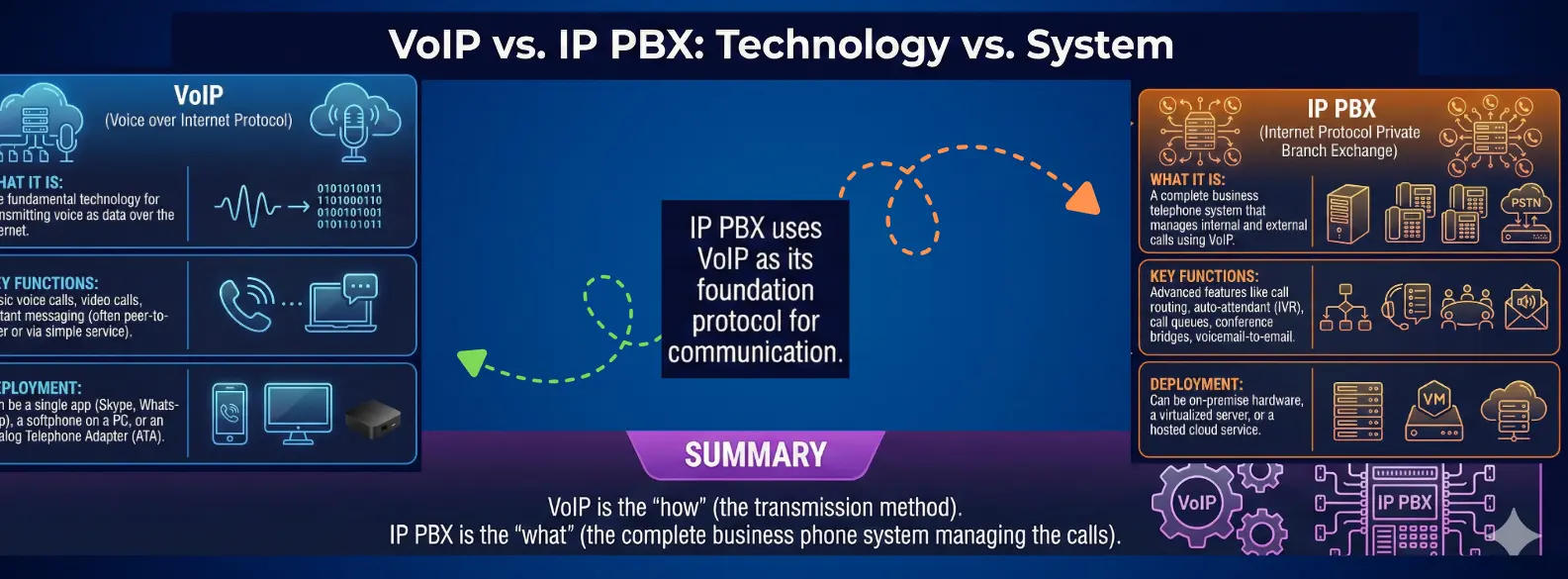
Many business owners and IT managers find themselves confused when comparing VoIP and IP
PBX systems for their company's communication needs. Both technologies use internet
protocols to handle phone calls, but they serve different purposes and offer unique
advantages.
This guide was created for office managers, IT decision-makers, and owners of small to
medium-sized businesses who need to understand these communication options before making
an investment.
We'll go over the benefits of VoIP technology and how IP PBX systems function for
companies. Along with real insights into costs and setup, you will also learn about the
important technical differences that are relevant to your particular case. You'll be
able to determine which option best suits your budget and business needs by the end.
VoIP, or voice over internet protocol, totally changes the way we communicate. VoIP transforms your voice into digital data packets that use the internet not special phone lines, comparing to traditional phone systems. While VoIP may be referred to as IP telephony, internet telephony, or internet phone service, it truly stands for Voice over Internet Protocol.
A reliable broadband internet connection
Internet Protocol Private Branch Exchange, or IP PBX, is a communication system that
uses Internet Protocol not standard circuit-switched networks to send voice and other
data. Most of modernVoIP phone systems
use this technology to handle calls over a data
network.
Traditional PBX systems create a unique voice network from the company's data
infrastructure by using physical switchboards and analog phone lines. IP PBX, on the
other hand, links various networks so that data, voice, and video can all go over the
same network design.

Businesses can make informed selections for their communication needs by being aware of
the differences between these technologies. According to popular thinking, VoIP and IP
PBX have different functions in the communication system.
They are very different from one another. VoIP is the technology that changes analog
messages into digital packets so that voice can be sent over the internet. On the other
hand, IP PBX works as a whole phone system that uses VoIP technology to handle calls
inside a company.
In terms of scalability, growing PBX systems requires the expensive and costly
installation of new phone lines and systems. As an alternative, VoIP allows companies to
just buy additional IP phones and grow their customer base.
The needs for maintenance also change greatly. While hosted VoIP companies manage
backend operations remotely, PBX systems require specialist IT personnel for control.
The decision between VoIP and IP PBX comes down to your unique business needs and
available resources. For companies looking for basic internet-based calling capabilities
without making significant infrastructure investments, VoIP is an affordable option. As
a result, this approach can be easier for smaller businesses or those with less IT
support.
As an alternative, IP PBX offers a complete communication system that is perfect for
businesses who require more control over their telecoms infrastructure and advanced call
management tools. This technology provides improved skills for complex business
settings, but it requires more technical skills to maintain.
When creating your communication strategy, the differences between these technologies
are crucial. IP PBX is the entire system that controls such communications within your
company, while VoIP is the basic technology that makes speech transmission over the
internet possible. As a result, a lot of companies really use both, with VoIP serving as
the IP PBX system's communication method.
Assess your present infrastructure, financial rules, technological skills, and future
growth goals before making a choice. Additionally, think about whether you would rather
have an on-premises system that gives you more control or a hosted option that requires
less upkeep. In any case, both technologies offer great advances over traditional
telephone systems, prepare your company for the current and future digital communication
environment.