www.gsmgateway.in

Having quick, friendly customer service is now key in today's cutthroat corporate world.
Businesses in all sectors are searching for more intelligent ways to handle consumer
contacts, cut operating costs, or speed up reply times. Interactive Voice Response (IVR)
is a device than is now key to satisfying these goals.
Cloud-based IVR solutions gives companies an open, scalable, or low-cost way to simplify
client interactions, against to traditional phone systems that call for big hardware
expenses and ongoing maintenance. Cloud IVR systems may ease communication and improve
the client's satisfaction, if it's a manager of a growing call center, a hospital call
center, a banking service center, and an online client service team.
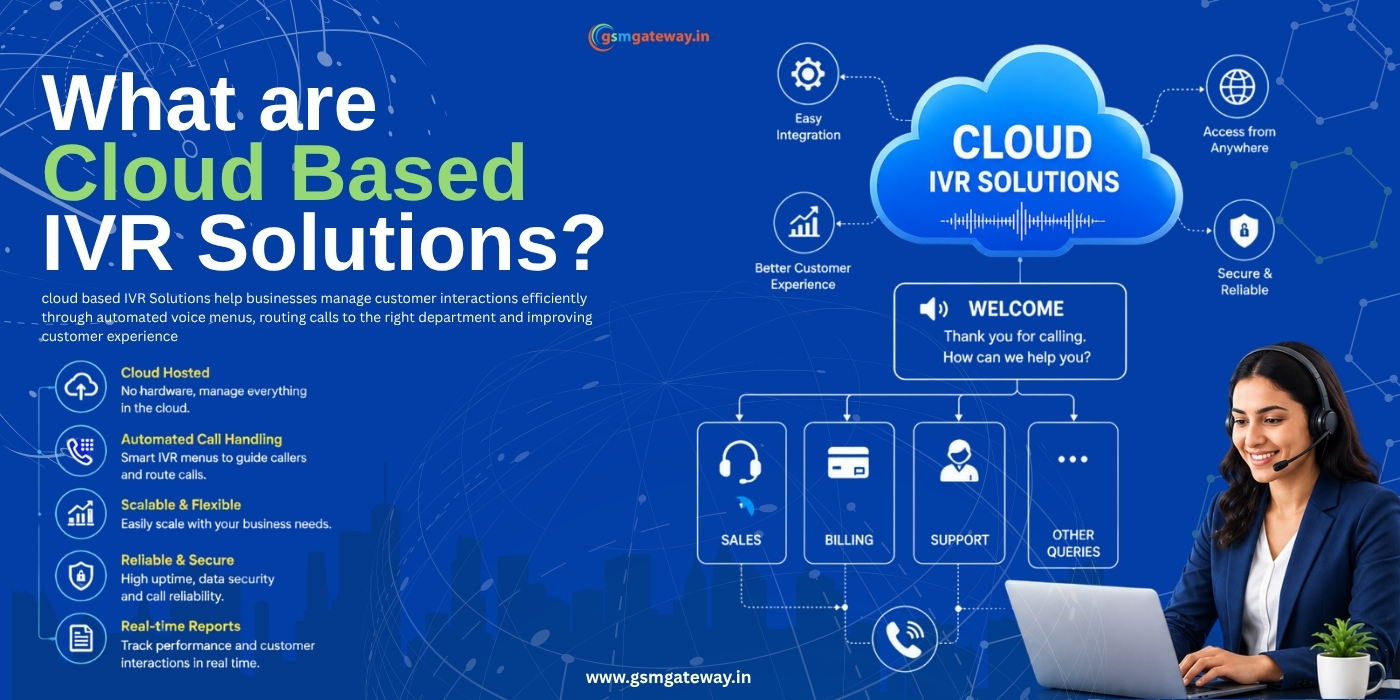
Applying voices with key input, users can speak using a company phone line using Interactive Voice Response (IVR), a digital telephone service. Clients are taken by online menus to select the right section, get data, and do basics manually, than wait on live support at once.
A cloud-hosted phone system it regularly accepts incoming calls, connects with callers for voice inputs of key inputs, or leads users to their proper division or self-support choice is known as a Cloud IVR (Interactive speech Response) system. Voip lacks costly on-premises hardware as it works via the web, like traditional IVR systems.
Interactive Voice Response (IVR) systems are now a key part of current call
handling as companies try to improve client service that speed calls. Companies
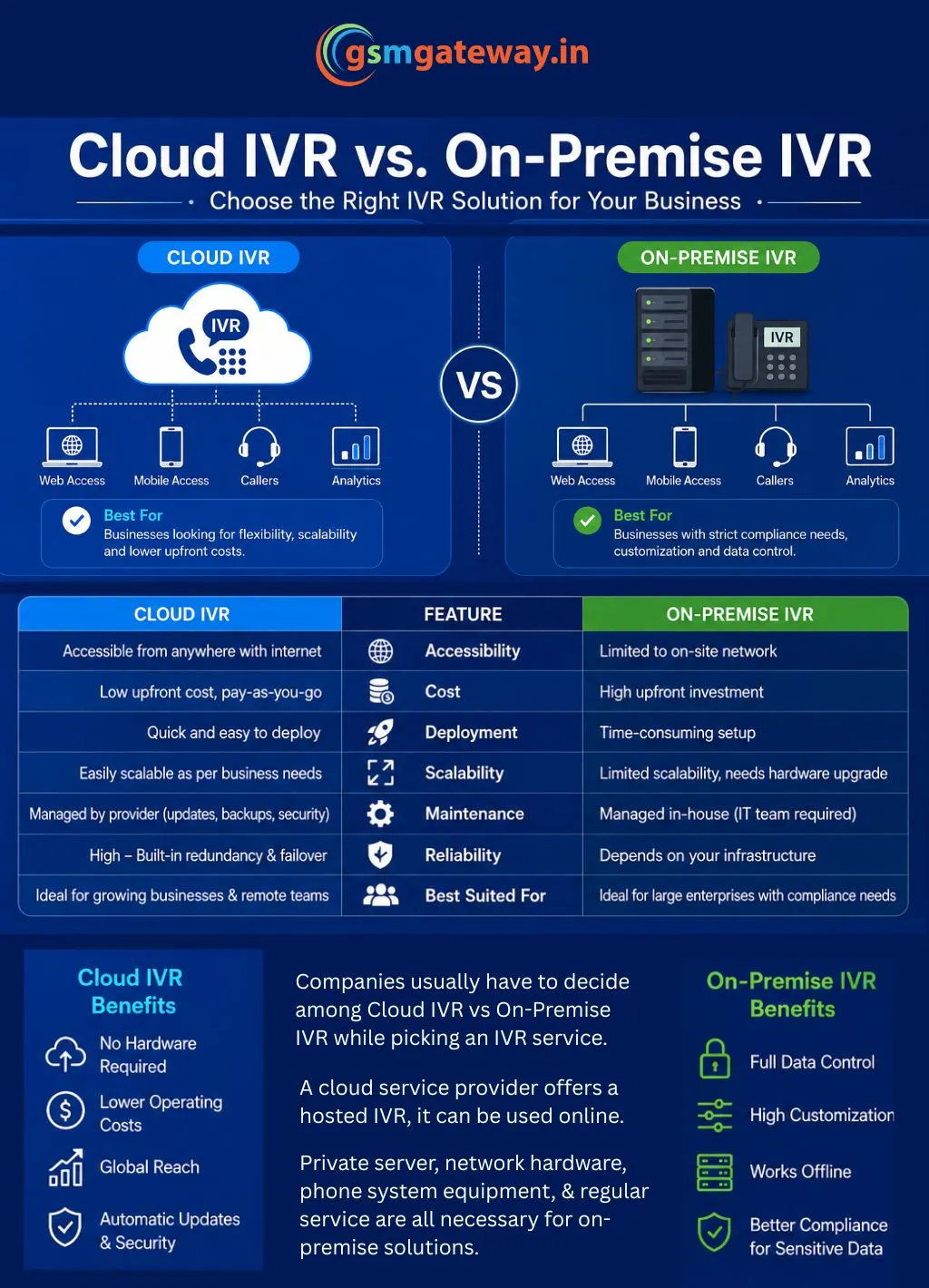
usually have to decide among Cloud IVR vs On-Premise IVR while picking an IVR
service.
While both solutions help with automate incoming calls as sending clients to a
right unit, their costs, set-up, service, performance, and range all very
different. To help in deciding which one suits what your business wants, this
paper analyses Cloud IVR vs On-Premise IVR systems.
A cloud service provider offers a hosted IVR, it can be used online. Your join a system via a virtual display, or the company maintain the system than installing server or telephone devices at your office.
Private server, network hardware, phone system equipment, & regular service are all necessary for on-premise solutions. With on-premise deployments, internal IT teams manage upgrades, backups, and troubleshooting. Modern businesses increasingly support hybrid and remote work.
Choose Cloud IVR if have a new startup, SMB, a growing business, needing simple
set up, easy CRM connection, online user help, the ability to handle changing
incoming calls with being to work on real devices.
Choose On-Premise IVR if Then you has a solid record system, work for a
regulated industry that strong data privacy demands, plus possess the highly
qualified inside IT staff need to manage the telephone devices.
A few if the key features in IVR system is smart call routing. So as to pair clients to a right contact, it assesses customer data, company policies, or broker availability. It saves calls, reduces delays, but improves call resolution. Also, skilled-based forwarding insures clients stay in connect only sellers that best qualify to handle their unique problems.
Businesses may develop complex IVR menus which are unique to the services, giving clients to quickly reach sections like marketing, invoices, or service.
A key reason why business buy IVR software was to allow personal service. These systems reduce call center functions and offer consumers with quick, 24/7 support for handling simple tasks, such like verifying funds, monitoring requests, scheduling meetings, billing, and viewing account data without any need of human input.
Premium IVR software includes a call recording to help business in training staff, service level tracking, or compliant testing. Business can uphold excellent, regular quality of service after each task using these files, which offer full insight into user problem points, agent output, or process issues.
IVR software that's online gives flexibility needed to advance with business needs grow. Business don't have buy new devices or completely update their systems just to add clients, grow phone systems, and handle higher call volumes. Also, an using the cloud gives high capacity, auto updates, or virtual access, making is a great choice to remote teams for business growth.
The quality of call support, client satisfaction, plus ongoing operation costs may all
be seriously affected with selection a IVR service provider. In select a solution,
business must consider many key factors is terms of cost.
Based on call traffic, the number of IVR levels, language support, or if you require
advanced handling or CRM integration, pricing can range in ₹1,500 to ₹10,000 per month.
Smaller groups can benefit from entry-level plans with simple menus, while higher tiers
usually have more analytics, premium support, and intelligent routing.
Before making an offer, it is important to request a complete, full cost break from any
provider because setup costs, add-ons, and per-minute call rates aren't always in the
headline price.
Recording your present call flow to figure out where calls get missed, blocked, or
dropped is useful if your setup still depends on on-premise hardware or an IVR that was
not used for a few years.
GSMGateway.in For companies looking to update their call handling without the cost of
physical equipment, it develops cloud IVR solutions. Get in touch with the team for a
demo if you want to see how a cloud IVR setup will fit your call flow.