www.gsmgateway.in

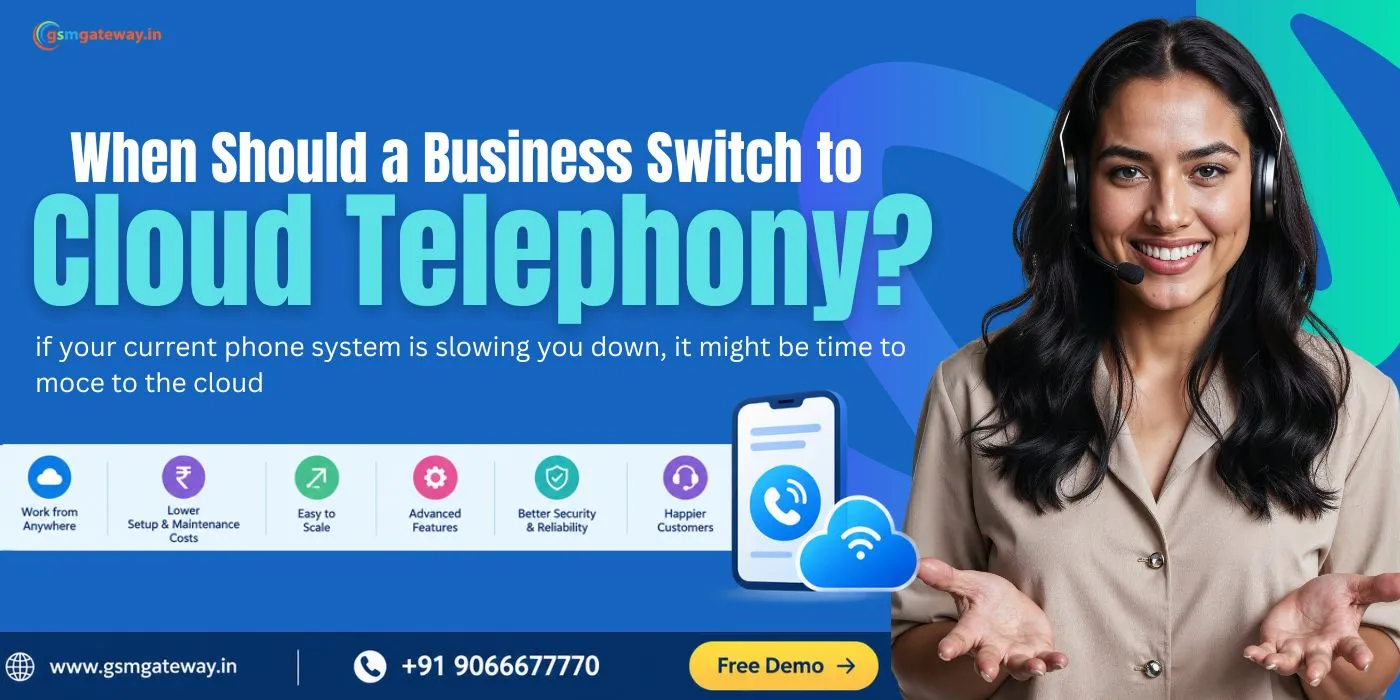
Every successful firm relies greatly on good communication. A working business phone
system is a must for answering client inquiries, scheduling sales teams, helping current
clients, and handling online staff. Traditional telephone systems, as a result, are
costly, hard to use, and costly to grow as a business grows.
That's why cloud telephony
can have a major impact.
A cloud-based calling system allows
businesses to handle calls and other types of messaging services over the web, unlike
focusing only on traditional in-premise telephone devices.
But where can you tell if a moment is right for the change? These are a few key signs
why a business may benefit from a cloud telephony system.
Growth is one of the simplest reasons to look into moving to a cloud-based telephony
system. If the business grows, you may need more staff, phone numbers, extensions,
departments, and customer service skills.
For a typical phone system, enabling new users can require hardware installation,
wiring, configuration, and ongoing service.
A cloud-based system can make
expansion a
lot easier.For businesses that are adding employees or opening new locations, a cloud
calling
solution can provide greater flexibility without requiring extensive physical
infrastructure at every location.
A cloud calling solution may offer more options for companies that are growing
the staff
or adding more offices with the need for costly physical systems in each location.
A regular office phone system may not offer the freedom needed by this kind of worker.
The hosted cloud telephony system, on one hand, lets employees use business interaction
offerings from anywhere with a browser and approved access.
This can help businesses maintain a consistent communication experience even when
employees are working outside the office.
For businesses with hybrid or remote teams, a cloud-based phone system can offer
a central way to handle business calls while having everyone be physically attached to
an office phone.
Businesses must assess the total cost of managing their interaction network. Traditional
systems can require hardware purchases, upgrades, upkeep, technical support, and
physical support.
As equipment becomes older, repair and replacement costs can also increase.
Moving to a cloud telephony solution can shift much of the communication
infrastructure
away from on-site hardware.
Depending on the provider and plan, businesses may
have more
predictable operating expenses and fewer physical systems to maintain.
Going towards a cloud telephony solution may free up a lot of the messaging network from
on-premises hardware. Based on the supplier and plan, businesses can face more regular
operating costs and fewer physical systems to repair.
Customer care teams often don’t need anything more than inbound and outbound calling. It
may require tools like call routing, interactive voice response (IVR), call recording,
call queues, hourly routing, or reporting.
If your current phone system makes using such functions hard or costly, it could be the
time to explore cloud telephony.
A modern cloud calling system may merge multiple communication services into a central
system. That helps brands better manage incoming calls to lead clients into the right
team or department.
The end result might be a more structured calling workflow and more insight into
connection action.
Business needs change quickly. One company might need to bring on temporary help during
a busy season, start a new sales campaign, or build a new client service team.
Growth in traditional telephone networks may require new hardware and expert
configuration.
A cloud based phone system is designed around internet-based infrastructure,
which can
make adding users, extensions, and other services more convenient.
Being flexible is very helpful for startups, developing firms, e-commerce businesses,
sales teams, and client service activities.
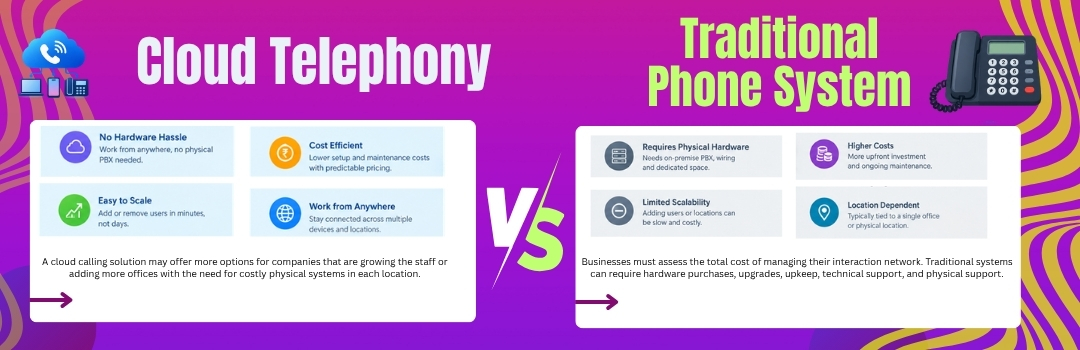
The decision between traditional telephony and cloud telephony is dependent on your company's needs.
Traditional solutions are usually built on physical telephone network and on-premise
hardware.
Common Characteristics :
Cloud telephony uses internet-based equipment and typically functions by a cloud system.
Common Characteristics :
You can get important business info from L data. Companies may want to know how many
calls they get, how many they miss, what their agents do, how quickly they respond, or
how good their client service is.Report functions on older phone systems may be limited,
and they might want extra tools.
When you choose a cloud phone service, based on
the provider and package you pick, lots of them will offer auto reporting and analytics.
That can help managers keep track of how conversations flow and discover ways to
improve.Access to correct call data may also help sales and support staff assess their
success and plan their tasks.
Problems with interaction may manifest in new regions or cities. Additional technical
work or facilities may be required to establish a standard telephone system at each new
location. Cloud telephony solutions enables a
business to set up a consistent system of interaction between multiple locations.
Businesses may use a single platform to oversee users, numbers, routing, and calling
policies, than keeping fully different systems that each office.
This has a chance to improve governing processes as the business expands.
There are surprises, like office closures, web issues, power cuts, or similar business
issues that all have effects on regular office interaction.
Cloud telephony helps with company backup by enabling licensed users to handle calls
from various locations, based on their provider's equipment or setup.
However, programs shouldn't trust cloud computing to avoid every risk. For developing a
stable communication system, it is important to assess internet access, provider access,
user devices, and backup options.
There is not a certain company size or sales level at which every company should move to
cloud telephony. The most that timing relies on your outreach needs, growth goals,
current systems, budget, and workforce model.
Consider switching when several of these situations apply:
GSMGateway.in is a platform where companies can experiment with new ways to communicate, and it should be considered in the review of cloud messaging systems. When picking a service, groups need to consider things like price, call quality, scale, number of access, ease of use, security, customer support, reporting options, and trust. The goal must not be just replacing an outdated phone system. It is to choose a way to interact that reflects how the business runs now but allows all future growth.
When their traditional communication systems hinder their growth and independence,
businesses often choose to move to cloud telephony, often at a cost. If you’re adding
remote employees, dealing with high call volumes, and looking for new ways to
incorporate phone calls into company apps, a cloud-based phone system is worth
considering.The correct cloud telephony service can provide a scalable way for a company
to handle
voice calls.
Knowing what you need now is the first step if you are a startup
building a
messaging system from scratch or a major company modernizing a standard telephone
system. When choosing the switch, consider current costs, business workflows, staff
requirements, connections, and future growth. Given proper planning, a managed cloud
telephony solution can grow into a crucial part of any current business interaction
plan.