www.gsmgateway.in

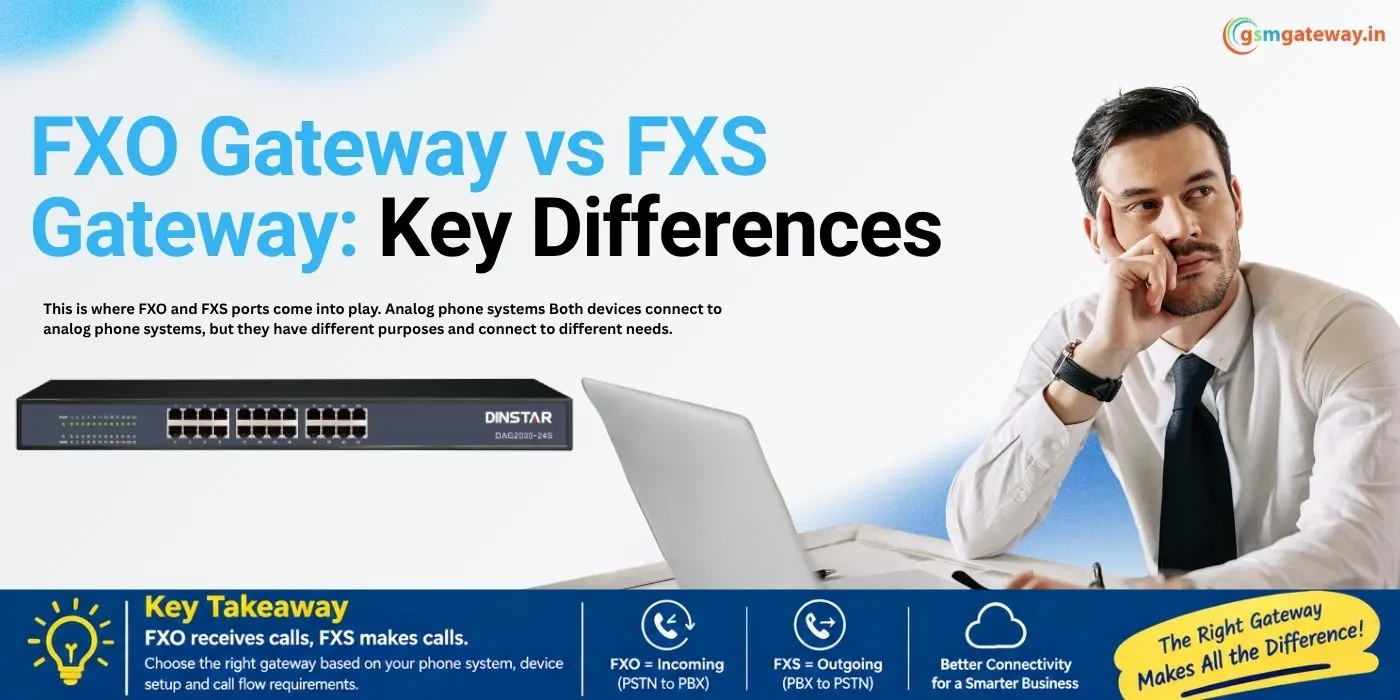
Nowadays, businesses typically have to integrate their legacy phone systems with VoIP,
IP-PBX, cloud telephony or call center platforms to make calls. This is where FXO and
FXS ports come into play. Analog phone systems Both devices connect to analog phone
systems, but they have different purposes and connect to different needs. to analog
phone systems, but they are designed to do different things and to meet different
connectivity needs.
For telecom resellers, system integrators, IT managers,
call center operators and enterprises looking to upgrade their communication
infrastructure, it’s important to understand the gap between an
FXO Gateway and an FXS Gateway.This tutorial explains the functionality of each gateway, its
applications, and theconfiguration process for FXO and FXS to ensure reliable
business communication.
An FXO gateway is a telecommunications device that converts analog telephone lines from
a traditional telephone network to a VoIP or IP-based communication system.
FXO stands for Foreign Exchange Office. An FXO port is designed to accept a telephone
line from a service provider, PBX, or other telephony source.
It does not
provide a dial
tone for a telephone.For example, a company may still have traditional PSTN phone lines
but prefer to employ an IP-PBX or VoIP-based contact center system. An FXO Gateway can
connect the analog lines to the IP network.
An FXO gateway can be useful for:
An FXS gateway makes the other type of connection. The term FXS stands for
Foreign
Exchange Subscriber.An FXS port offers the telephone service interface needed by
an
analog phone, fax machine, or other analog endpoint. It provides dial tone, ringing
power, and proper signaling to the connected device.
Typically, an FXS gateway is
used when a company wants to connect legacy analog devices with a VoIP or IP-PBX
system
For example, a company may have several desk telephones, but prefer to handle calls
through its IP-based communication system. An FXS gateway can connect the analog phones
to the IP network.
Typical applications include:
The simplest way to understand Fxs vs fxo gateway technology is to remember what each side connects to.
| Feature | FXO Gateway | FXS Gateway |
|---|---|---|
| Full form | Foreign Exchange Office | Foreign Exchange Subscriber |
| Connects to | Analog telephone line | Analog telephone/fax device |
| Main function | Brings analog lines into VoIP/IP systems | Connects analog endpoints to VoIP/IP systems |
| Provides dial tone | No | Yes |
| Typical connection | PSTN line → FXO → VoIP | VoIP → FXS → analog phone |
| Common use | PSTN-to-VoIP integration | Analog-device-to-VoIP integration |
In classical telephony, an FXS interface and an FXO interface are typically helpful.
Consider a basic setup:
Telephone Service → FXO Gateway → IP Network → IP-PBX
The FXO gateway receives the analog telephone line and converts it to a VoIP-based
connection.
Another configuration could look like:
IP-PBX → FXS Gateway → Analog Telephone
In this case, the FXS Gateway serves as the analog telephone interface, while the IP-PBX
handles calls via the IP network.
Businesses can use each gateway only or mix them based on their current systems or
communication needs..
Correct FXO and FXS configuration is important for call quality, signaling, routing, and system security.The configuration requirements change according to the gateway model, IP-PBX, telecom line, and network design. However, multiple areas often require care.
Choosing between an FXO and FXS gateway depends primarily on what you are trying to connect.
In certain scenarios, both may be required. For example, a company may have traditional telephone lines on one side and legacy analog phones on the other, with an IP-PBX allowing central call management between the two.
Call centers are typically complex communication environments that make use of dialer
software, IVR systems, SIP trunks, IP-PBX platforms and
legacy telephone systems
An FXO gateway can help a business integrate existing analog lines into an IP based call
center network.Meanwhile, an FXS gateway can aid in the keeping of unique analog
endpoints where
replacing old equipment is costly.
This can make it easier for BPOs,
corporations, healthcare
companies, financialinstitutions, school systems and other industries to do phased
infrastructure
upgrades .Also consider the appropriate gateway in relation to port density, SIP
support, call
routing needs, network design and future growth plans.The ideal gateway should also be
considered
in terms of port size, SIP support, call routing requirements, network design, and
future growth plans.
The wrong choice of gateway can lead to an incorrect connection between the telephone
service, the IP infrastructure and the endpoint.For example, an FXO port connects to
a telephone line, while an FXS port connects to the analog telephone equipment.
Understanding the difference before buying or configuring equipment can help you avoid
avoidable deployment issues.The decision should therefore start with a simple
question:
Are you connecting an analog telephone line or analog telephone
equipment to your VoIP
system ?
If you're connecting the line, you'll require FXO. In most cases, FXS is required while
connecting a phone.
Gateway selection should go beyond simply counting ports. Businesses
should consider:
Gsmgateway.in sells telecom equipment and communication solutions to businesses,
telecom
providers, system integrators and call center setups in India.
Gsmgateway.in has experience in dialer software, IVR solutions, call center
software and
cloud call center services.
Instead of seeing gateways as unique devices,
businesses can
use them to examine how they fit into a larger communication structure.
Whether the goal is to connect an analog network to an IP-PBX, support a call center
environment or plan a larger VoIP deployment, choosing the right gateway and
configuration is a key ingredient to creating a system that is reliable.
The difference between an FXO gateway and an FXS gateway results from
their connectionand role in the telecommunications network. An FXO gateway connects
analog telephone lines to an IP/VoIP system, whereas an FXS gateway connects analog phone
devices to an IP/VoIP system. Once this fundamental point is understood, planning the
suitable FXO and FXS setup becomes much easier.
Customers looking to compare FXS vs.
FXO gateway solutions should consider their current telephone infrastructure, desired
VoIP design, port count and communication needs.Planning a VoIP, IP-PBX or call center
deployment and need help selecting the best gateway design ? Contact Gsmgateway.in We
can help with a focused consultation or a product inquiry targeted to your business
requirements.